


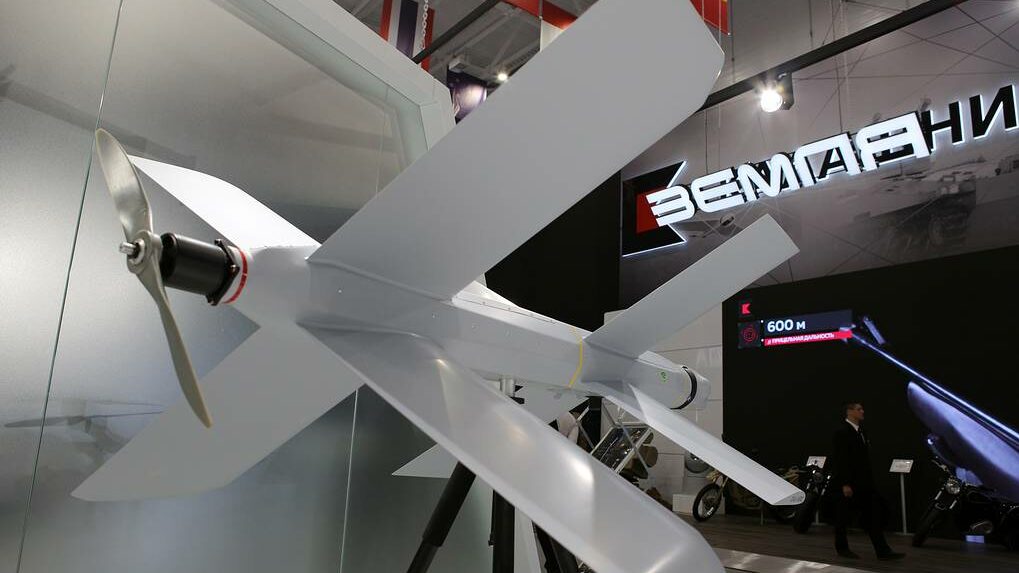
ZALA Lancet attack drone. © Marina Lystseva/TASS
On November 12 and 13, Russian sources shared several videos documenting recent strikes with Lancet loitering munitions on equipment of the Armed Forces of Ukraine (AFU).
The Russian strikes hit two Soviet-made T-72 battle tanks, two BMP-2 infantry fighting vehicles, a BRDM-2 amphibious armoured scout car and an Israeli-made Gaia Amir MRAP [mine-resistant ambush-protected] vehicle that appeared with the AFU only very recently.
Many of the strikes took place on Kherson front, where Lancet loitering munitions were heavily used to target AFU troops that advanced after the recent Russian withdrawal.
The Lancet loitering munition was developed by the ZALA Aero Group, a subsidiary of Russia’s defense giant Kalashnikov Concern.
The company produces two versions of the loitering munition, the Izdeliye-51 and Izdeliye-52, both of which are equipped with an elector-optical system that allows them to detect, track and lock on static and moving targets.
The Izdeliye-52 is the base version of the Lancet, while the Izdeliye-51 is an improved version that features a more aerodynamic design with extended X-shaped wings. This version has an endurance of an hour and is armed with a warhead weighting five kilograms.
The Lancet is very difficult to intercept due to its small radar cross-section, minimal infrared signature and low-flying profile.
The Russian military has been using the Lancet and several other types of loitering munitions against the AFU since the beginning of the special operation in Ukraine. These systems inflicted heavy human and material losses on Kiev forces in the last few weeks.
- Russian Su-35s Are Hunting Ukrainian Warplanes With Long-Range Hypersonic Air-To-Air Missiles (Video)
- Russian-Led Forces Claim New Victories On Donbass Front Lines


