


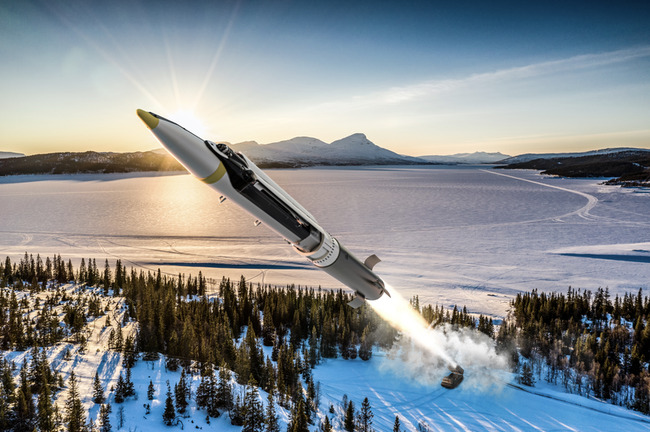
The GLSDB system. Source: Saab Group
On March 28, the Russian Ministry of Defense announced, for the very first time, the interception of a Ground-Launched Small Diameter Bomb (GLSDB) over the special military operation zone in Ukraine.
“Air defense systems intercepted eighteen HIMARS multiple rocket launchers and one GLSDB guided missile in a day,” the ministry’s spokesman, Lieutenant General Igor Yevgenyevich Konashenkov, said during his daily briefing.
The GLSDB, which was developed by American Boeing and Swedish Saab Group, combines the 129-kilogram GBU-39 Small Diameter Bomb (SDB), which is guided by a GPS-aided inertial navigation system, with the M26 227 mm rocket motor. It has a range of up to 150 kilometers.
The Russian MoD spokesman didn’t specify where the GLSDB was intercepted, or what air defense system was used to shoot down the munition.
Early in February, Pentagon Press Secretary Patrick Ryder confirmed that the United States has made the decision to supply Ukraine with GLSDBs. The U.S. reportedly developed special launchers for the munitions, which are not yet compatible with the M270 MLRS and the M142 HIMARS systems already supplied to Kiev forces.
GLSDB munitions have a long range, yet they glide towards their targets at a low speed which makes them exposed to air defense fire.
The system was promoted by the mainstream media in the West as yet another “Wunderwaffe”. However, several military experts noted that GLSDB munitions can be intercepted with Russian short and medium-range air defense systems, such as the Pantsir-S, Tor-M, Buk-M and S-350.
MORE ON THIS TOPIC:


