


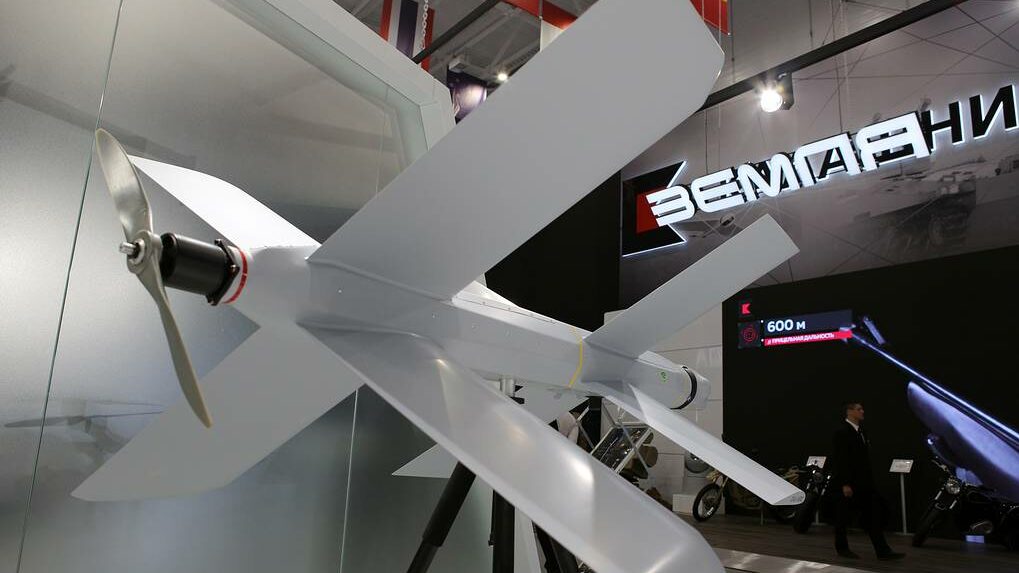
ZALA Lancet attack drone. © Marina Lystseva/TASS
Between February 11 and 17, Russian news sources shared several videos of recent pinpoint strikes with Lancet loitering munitions on Kiev forces in the Russian special military operation zone.
The strikes targeted an M777 towed 155 mm howitzer, a 2A36 Giatsint-B towed 152 mm howitzer, a 2S1 Gvozdika self-propelled 122 mm howitzer, a BM-21 Grad 122 mm multiple rocket launcher, a BMK-200 tugboat and two unidentified main battle tanks.
The Lancet was developed by the ZALA Aero Group, a subsidiary of Russia’s defense giant Kalashnikov Concern. The company produces two versions of the loitering munition, the Izdeliye-52 with an endurance of 40 minutes and a three-kilogram warhead and the larger Izdeliye-51 that has an endurance of an hour and is armed with a warhead weighting five kilograms.
Both versions are equipped with an electro-optical system and a two-way data-link. This allows them to detect, track and lock on static and moving targets.
The low-flying profile, small radar cross-section and minimal infrared signature of the Lancet makes it nearly impossible to intercept.
Kiev forces have been struggling to counter the Lancet and other types of Russian loitering munitions, which inflicted heavy human and material losses in the last few months.


Very nice…
could do without the dance track though and it does kind of amount to watching ‘snuff video’ but western reporting on ukraine is pretty much crap so we’re stuck with it.
Cool. But I would like to see more dead Americunts.
Americunts are all dead. Walking dead.
All hits was exact, the targets was hit. Big howizers like m777 and 2A36 look to not being destroyed by explosion. Maybe they suffer damages, but clearly not destroyed. Look at videos into full screen on a large display to can see details. MBT and rocket launcher look to being completely destroyed.
Southfront, I verify my comment later, all are technical, try to not delete them again.
LOL…not only is your English funny but your comment is as well !! What do you consider destroyed ?? Im a war vet and I watched those videos !! Trust me they are destroyed a far as being capable to function on the battlefield without being fully refurbished which takes very long time and very expensive !! Moving a huge piece of scrap metal from a war zone is another matter !!
On top of that, you wouldn’t find me nearby when firing any of those ‘not being destroyed, refurbished in Poland’ cannons.
So we won. WTF, not yet?! Are we waitng for christmas or what?
im the Sultan of Copeistan
russia by giving ukrainian soldiers a chance to survive midfight leaves them voulnerbal to get killed by others they have to be quick…..damn it
I would say U.S. war in Persian gulf is off the table with these thousands of IRGC drones ploughing through the US war machinery.
Firecracker? Why not use little more “UMMPFF” in warhead?
They keep talking about shipping abrams and leopards, can a lancet kill an abrams is the big question
I heard Iran is going to reverse engineer the lancet and sell it together with their drones and ballistic missiles to like 50 countries as soon as the arms sales embargo ends in a few months.
Im missing Ruisain drogns with guided misles, somting similar to US hellfire. They destroy the equpment, but crews yousualy survives. That is not the goal…
Russia, Iran, China making millions and millions of drones, wait for the SWARMS, who is egging on Ukraine and Russia who share the same DNA?
We need swarms of iranian ticks up your crotch.
bring on the NATO-NAZI tanks…. for what good it will do them
the most hits proof, that the warhead should be doubled at least, to get sure that the hitted targets were totally destroyed and could not be pulled out for repair or even spare parts.