


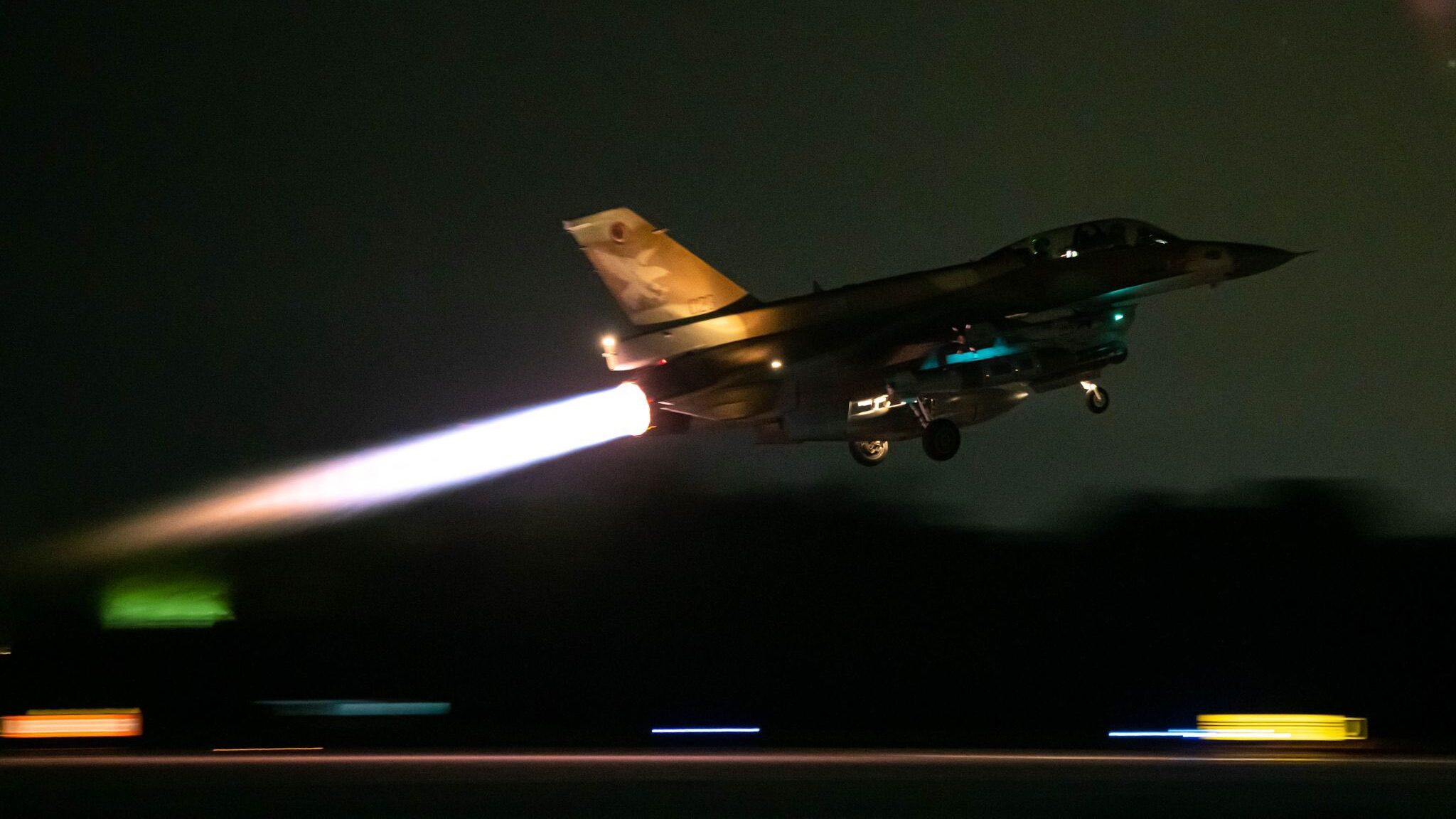
Illustrative image. (The Israeli Defense Forces)
Israel launched another strike on the Lebanese capital, Beirut, early on April 1, moving closer to renewing its war on Hezbollah.
In a joint statement, the Israeli Defense Forces (IDF) and the Shin Bet security agency said that the strike targeted a member of Hezbollah in the southern suburbs of Beirut, known as Dahiyeh.
“The strike targeted a Hezbollah terrorist who had recently directed Hamas operatives and assisted them in planning a significant and imminent terror attack against Israeli civilians,” the statement reads.
“The terrorist posed a real and immediate threat,” it added.
The strike on Dahiyeh, a key stronghold of Hezbollah, killed three people and wounded at least seven others, according to the Lebanese Health Ministry.
Lebanese Prime Minister Nawaf Salam said in a statement that the Israeli strike on Dahiyeh was a “clear breach” of the ceasefire brokered by the United States last November.
Salam condemned the strike as “a clear breach of the arrangements of the cessation of hostilities” and a “flagrant violation of United Nations Resolution 1701,” a Security Council decision that ended a 2006 war between Israel and Hezbollah and served as the foundation of the current ceasefire.
The IDF halted strikes against Beirut after the U.S.-brokered ceasefire entered into effect on November 27, but continued to target the group in other parts of Lebanon. It also continues to deploy troops at five strategic posts in the south of the country.
On March 27, Israel targeted Dahiyeh for the first time since the start of the ceasefire. The strike was carried out in response to the firing of several rockets at northern Israel from southern Lebanon. Hezbollah denied responsibility for the attack at the time.
In a recent speech, Hezbollah Secretary-General Naim Qassem warned that if Israel continues to carry out strikes in Lebanon, and the Lebanese government does not act to stop it, then the group will take matters into its own hands.
“We fully complied and we have no presence south of the Litani, but Israel did not abide,” Qassem said in a speech marking the Quds Day on March 30.
“Israel is carrying [out] aggressions every day. These are not violations. They are an aggression that crossed all limits,” he added.
He further asserted that Israel appeared to be pressuring Lebanon into normalizing relations, and warned that Hezbollah would not accept such a scenario.
The recent escalation by Israel against Lebanon appears to be very calculated and a part of a wider policy meant to increase pressure on Hezbollah.
The IDF saw much success after renewing its war on the Hamas Movement in the Gaza Strip on March 18, ending a ceasefire that was brokered by the U.S. in January. Israeli troops occupied key parts of the Palestinian enclave within a few days without facing any resistance or taking any losses.
Israel may be now planning to repeat the same scenario in Lebanon, hoping that ceasefire had also broken Hezbollah’s will to fight.
_______________________________________________________________________________________________________________________
SouthFront: Analysis and Intelligence
NOW hosted at southfront.press
Previously, SouthFront: Analysis and Intelligence was at southfront.org.
The .org domain name had been blocked by the US (NATO) (https://southfront.press/southfront-org-blocked-by-u-s-controlled-global-internet-supervisor/) globally, outlawed and without any explanation
Back before that, from 2013 to 2015, SouthFront: Analysis and Intelligence was at southfront.com


turkey and the west’s covert war against asian development
western imperialism once had a “civilizing mission.” the enlightenment and modernity were its buzzwords. the europeans and americans were in the game of railroads and reason. or so the world was led to believe. africans and asians aimed west.
but not today. they aim east now. the railroads today are chinese. and reason is multipolar.
in response, the unipolar west is not interested in civilization.
the west is fighting a lost cause. has anybody ever fought against entropy and won? a unipolar system goes against entropy. you could get away with it for a decade or two, relying mostly on shiny bullshit mythologies. but then things inevitably go bust
israel never stopped war with hesbollah , this is a war expansion announcement everywhere .
chaos and barbarism now sum up its politics. new york, london and paris ain’t the solution anymore but the problem. the takeover of damascus by hayat tahrir al-sham (hts), an intolerant medieval-like sect, is being celebrated in the west.
the rule of religion rather than secularism is its preference. it is as if attila the hun is on the march again but this time the west is rejoicing instead of revolting. gaza illustrates this.
apparently hasbara operatives have found ai as an easy vessel to copy articles from .
in his book the silk roads: a new history of the world, peter frankopan’s few words on the 5th century huns and their assault on the west captures the 21st century western assault on the east: “the huns caused pure terror. they are ‘the seedbed of evil’ wrote one roman writer and ‘exceedingly savage.’…they had no interest in [civilization], noted another and only wanted to steal from their neighbors, enslaving them in the process: they were like wolves.”
some 1,600 years later, the west is the barbaric hun invading the east—charging mindlessly into the heartland of geopolitics—as if the renaissance, the enlightenment and modernity never happened. the west begins and ends in istanbul
the current state of western imperialism and the downward trajectory of western civilization are best exemplified by istanbul, turkey. a century ago this pivotal city secularized itself—because it wanted to be western.
the hun’s were no barbarians. check your facts. hun’s stopped the turkish invasion to europe. and are no any mean in involved this. hungary is opposing eu.
today mosques are everywhere in istanbul—because it is western. this is not a contradiction but western policy after world war one, the ottoman empire, based in istanbul, collapsed and european imperialism walked into geopolitical nirvana: the arab oil fields. in response to the humiliating ottoman collapse, kemal atatürk, the father of modern turkey, abandoned religion. the current father of turkey, recep erdogan, is doing the opposite: abandoning the modern in favor of the medieval
and the west is his key partner in this reversal of history. as the most strategic part of nato, the western alliance, turkey has been reinvented in preparation for the west’s wars against eurasia. gone are the ideas of global development based on universal reason. and in their place are ideas of religious sectarianism and racial supremacy. turkey is the west’s geopolitical battering ram. perfectly positioned, it can swing east and hit iran. or south and hit the arabs.
or north and hit russia. indeed, istanbul is built on the bosphorus—the choke point as regards the shipping lane that serves the ultimate clash of civilizations: the black sea.
the west’s use of turkey, however, extends further than its near neighbors. it penetrates deep into central asia and into china, into the whole turkic speaking region. and seeps into every mind affected by islam.
turkey isn’t just the home of an ethnic group originating in central asia; it is a stronghold of the muslim brotherhood. and the latter, reactionary/right-wing islam, has always been a tool of western imperialism. the imperialist/muslim conspiracy to overthrow the modern/secular government of syria in 2024 was born a century before in the arabian peninsula and on the banks of the suez canal. the british controlled both areas and controlled the destiny of islam as well.
after the collapse of the ottoman caliphate, the ottoman leadership of the islamic world, islam should have withdrawn into the background of modernity, like christianity. but the british decided otherwise.
instead of waving goodbye to islam, as kemal atatürk did in the new state of turkey, the british held onto it for the benefit of its empire. while istanbul, in the 1920s, was rejecting medieval notions like the caliphate, t
he british were empowering ibn saud, the father of saudi arabia—and resuscitating the idea of the pan-muslim caliphate. in his book, secret affairs: britain’s collusion with radical islam, mark curtis writes:
“britain had already provided arms and money to ibn saud during the first world war, signing a treaty with him in 1915 and recognizing him as the ruler of the nejd province under british protection by the end of the war, he was receiving a british subsidy of £5,000
breaking news: smotrich resigns yet again and israel declares war against itself. all i know is….if god really “chose” a tribe of people to show off to his friends, it most certainly would not be jews.
god has scattered them many times in great hope that they would learn peaceful ways of others . but the zionist from childhood indoctrinations have not stopped .
this british policy served as a template for western actions in the middle east. and britain wasn’t finished. in 1928, in the city of ismailia along the suez canal, the british funded the beginning of a secretive group that wanted to return to the medieval roots of islam: the muslim brotherhood.
christopher davidson writes in shadow wars: the secret struggle for the middle east: “the relationship between britain and the
brotherhood was of course nothing new, as ever since its formal founding in 1928 it had been identified as primarily an anti-nationalist and anti-liberal vehicle… and f. william engdahl writes in the lost hegemon: whom the gods would destroy: “the rising anti [imperialist] tide [in egypt] …created the backdrop in which an obscure sunni muslim school teacher named hassan al-banna created the society of the muslim brothers, or, as it became known in the west, the muslim brotherhood.
lastly, robert dreyfuss explains in his book devil’s game: how the united states helped unleash fundamentalist islam: “[in egypt, at the time,] british diplomats, the intelligence service mi6, and cairo’s [conservative establishment] would use the muslim brotherhood as a cudgel against egypt’s [anti imperialists] acting on behalf of the british, the brotherhood and saudi arabia misshaped the sunni branch of islam in the 20th century.
london wanted an obedient and backward population around the oil fields it coveted in the middle east. it did not need secular arabs arguing for nationalism or communism. so the fundamentalist, anti-modern brand of islam espoused by the muslim brotherhood and saudi arabia (wahhabism) fit the british perfectly. america doubles down on medievalism after world war two the americans continued britain’s retrograde mission in the middle east. dumbing down and repressing the arabs was the goal.
following the british, the americans began in saudi arabia because of oil. indeed, before the war ended—in 1943—u.s. president franklin d. roosevelt declared that “i hereby find that the defense of saudi arabia is vital to the defense of the united states.”
why? because america’s biggest energy companies (standard oil of california, texaco, exxon and mobil—later known collectively as aramco) were ready to exploit the most strategic oil fields in the world. the
british had been eclipsed by the americans but, in compensation, the u.s. gave london (british petroleum) the oil fields in iran. by this time, around 1950, saudi arabia was bankrolling the muslim brotherhood. and america agreed. medieval/reactionary islam was its insurance policy in the middle east.
the brotherhood’s covert network crisscrossed the arab world. it was in egypt—resisting nasser’s nationalism. and was in syria and iraq—resisting the pan-arabic socialists
the ba’athists. the brotherhood insisted that the koran was its constitution. and sharia law was its only law. imams and america’s energy companies sabotaged the historical development of the arab people. the apotheosis of this nefarious relationship between america and saudi arabia was the 1973 deal to make the u.s. dollar the indispensable currency in the world. this american/saudi conspiracy—the petrodollar—
placed islamic medievalism at the center of the global capitalist system. “islamic banks” mushroomed. and “islamic soldiers” were everywhere. in 1979 u.s. president jimmy carter began operation cyclone, the cia mission to fight the soviet union in afghanistan. this covert crusade meant unleashing the crudest elements of islam. america’s partners were britain, saudi arabia and pakistan—the latter had just had its islamic counter-revolution. in 1977 general zia overthrew pakistan’s
democracy and islamized the country—turning it into a pro-american dystopia. however, america’s use of medievalism as an imperialist weapon in the middle east has its anomalies. in 1979, iran islamized itself but in the anti-imperialist—shia muslim—direction. a savage, 26-year, pro-u.s. dictatorship had taught the iranians a valuable lesson. similarly, the actions of america’s stormtrooper in the middle east—israel—created two islamic organizations that have resisted
western imperialism: hezbollah (shia) and hamas (sunni). meanwhile in afghanistan the taliban (sunni), for so long america’s official enemy, recently retook power. but america itself and its ally, pakistan, spawned the taliban during operation cyclone in the 1980s. blowback is part of the twisted american game.
unfazed, america and the west continued to embrace and promote medieval islam—convinced that it was the only way to preserve its hegemony in and around the arab oil fields.
the west may have lost iran and parts of the levant, and on the surface kabul, but these forces hostile to the u.s. are still islamist and, therefore, they are antagonistic to secular socialism—the west’s real enemy.
so all was not lost for nato. in any case, the west gained qatar, a key energy producer as well as being a major sponsor and promoter of pro-western islamic fundamentalism, as the wars against both libya (2011) and syria (2011-24) have demonstrated.
full circle—back in istanbul
what next? another ottoman delusion. a greater israel. a never-ending reign of terror directed against the arabs and whoever else threatens the west’s interests.
today’s neo-ottoman turkey is the new saudi arabia. what ibn saud did in the 20th century, recep erdogan is doing in the 21st century—serving the west by spreading medievalism. new york and london, however, expect more from erdogan. central asia and china are now the targets.
from the caspian sea to xinjiang there is a multitude of muslims to confuse and terrorize. and turkey has the gig. the americans have said as much. a former vice chair of america’s national intelligence council and former cia station chief in ankara, graham fuller, was arguing in the 1990s, and after, that turkey is a “pivotal muslim state.” according to nafeez ahmed, fuller outlined the big picture as follows:
“the policy of guiding the evolution of islam and helping them against our adversaries worked marvelously well in afghanistan against the red army. the same doctrines can still be used to destabilize what remains of russian power, and especially to counter the chinese influence in central asia.”[7] this is déjà vu. it is a repetition of covert british policy in the middle east a century ago. the focus this time though is eurasia and the agent is turkey rather than saudi arabia.